
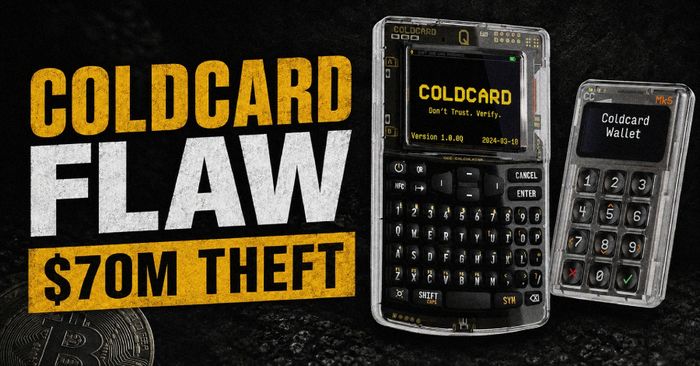
On July 30, 2026, an attacker swept 1,082.65 BTC — worth about $70.2 million — from 1,196 Bitcoin addresses in the span of 41 minutes. Galaxy Research traced the sweep to a firmware flaw that has quietly undermined Coldcard hardware wallets since March 2021. The flaw is in how the device generates seed phrases: instead of drawing from the STM32 chip’s dedicated hardware random number generator (RNG), a build configuration error routed seed generation to a deterministic software fallback called Yasmarang — MicroPython’s pseudorandom number generator. The libngu library checked whether the hardware RNG macro existed in the build rather than whether it was actually enabled (it wasn’t), so every affected device silently used a much weaker source of randomness from the moment the seed was created.
Because the pseudorandom generator was seeded from the chip’s unique ID, boot-timer registers, and a small history of prior RNG calls, an attacker with enough information about the device can reconstruct the candidate pool of seeds offline, derive the corresponding Bitcoin addresses, and check those against the public blockchain — without ever touching the physical wallet. Coinkite, the Canadian company behind Coldcard, estimates the effective entropy at roughly 40 bits on older Mk3 devices and around 72 bits on the Mk4, Mk5, and Q models, well below the 128 bits a proper 12-word BIP-39 seed should provide. Emergency firmware was released on July 31, but installing it does not fix an existing seed — the weakness is baked into the seed phrase itself, not the device’s current software.
How to check if you’re affected
Affected models are the Coldcard Mk3, Mk4, Mk5, and Q hardware wallets. Exposure depends entirely on which firmware version was running when your seed phrase was first generated, not the version installed now. If you set up your Coldcard after March 2021 and have not yet replaced the seed, treat it as potentially compromised.
Steps to take now:
- Download and install Coinkite’s emergency firmware for your model.
- Generate a brand-new seed phrase on the patched firmware — do not restore or re-import the old seed words, as doing so carries the weakness forward regardless of which device or firmware version you use.
- Send your funds from the old wallet to an address derived from the new seed.
- A strong, unique BIP-39 passphrase creates a separate wallet that the seed words alone cannot reach, but Coinkite still recommends replacing the seed rather than relying on the passphrase alone.
- If your seed was generated with at least 50 fair, independent, private dice rolls, Coinkite says it is not at risk from this bug — but if the number or privacy of those rolls is uncertain, migrate anyway.
TAPSIGNER, OPENDIME, and SATSCARD products use different codebases and are not affected. Multisig setups are only protected if the quorum includes at least one device not built from an affected Coldcard seed.