
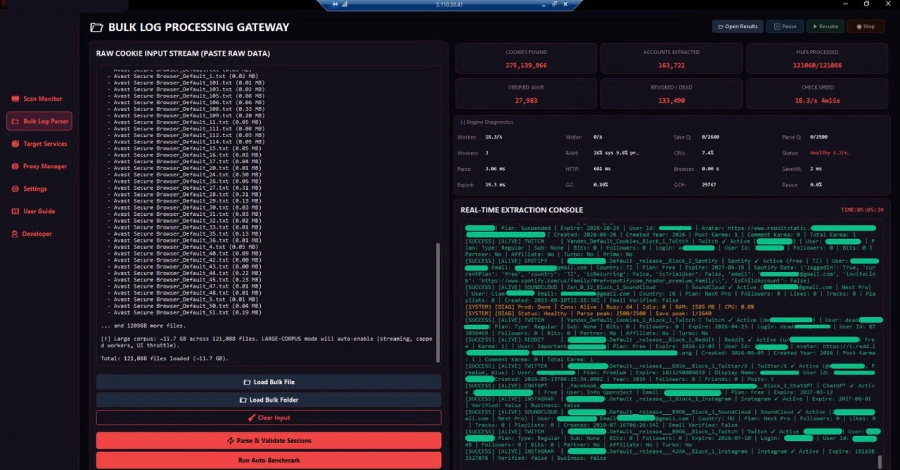
Researchers at Okta have found that information-stealing malware is capturing not just passwords but also the session tokens and API keys that AI services issue after a successful login — and those tokens can be replayed by attackers to gain full account access without a password or a multi-factor authentication code. Okta analyzed a 7 GB infostealer data dump published on a Telegram channel on August 2, 2026, and found it contained data from 5,871 infected machines across 162 countries. Among the stolen material were thousands of authentication tokens for services including Google, Microsoft, Anthropic (Claude), Amazon, Character.ai, Cursor, Poe.com, Gamma, Notion, and Pika AI.
Of the 44,791 unique JSON web tokens (JWTs) in the dataset, 555 were tied to AI service authentication. On the day the dump was released, 1,843 of those tokens were still unexpired and valid. A valid session token represents an already-completed login — which means MFA has already been passed. Replaying it bypasses the entire authentication chain. Additionally, 17.7% of the JWTs contained plaintext personal information such as names, phone numbers, and email addresses, which can be used independently for phishing and social engineering.
Infostealers like Lumma Stealer and Vidar, which are sold as ready-to-run tools on underground markets, are the primary vehicle. They run silently on a compromised device and harvest cookies, saved credentials, and session data from browsers and apps before packaging everything into a log file that is then sold to other attackers. The net result is that your AI account security is only as strong as the security of every device you’ve ever signed in on.
How to check if you’re affected
Affected products include ChatGPT, Google Gemini, Claude, Microsoft Copilot, and any other AI service where you stay logged in across browser sessions. If a device you use has been compromised by infostealer malware, your active sessions on these services may have been harvested.
To limit exposure: sign out of AI services on any device you no longer use or that you suspect has been compromised — this invalidates existing session tokens. Review active sessions in your account settings (most AI providers show a list of active logins) and revoke any you do not recognize. Use an antivirus or endpoint security tool to scan for known infostealers. If you received an alert that your email or credentials appeared in a data breach, treat your AI service sessions as potentially compromised and sign out everywhere, then sign back in.